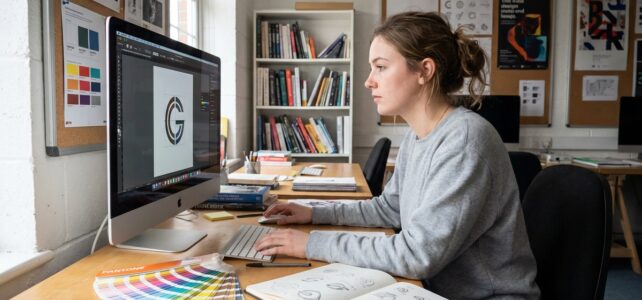
A student entering a bachelor’s degree in graphic design in 2026 no longer spends their first weeks placing blocks of text in InDesign. The first real-world constraint is a hybrid brief: to design a visual identity where part of the assets will be generated by an artificial intelligence tool, then retouched, adapted, and applied to interactive media. This starting point changes the very structure of the programs.
Transdisciplinary Workshops in Graphic Design: What Replaces the Lecture
Typography, color theory, and layout can still be found in educational mockups. This foundation has not disappeared, but it no longer occupies the center of the curriculum.
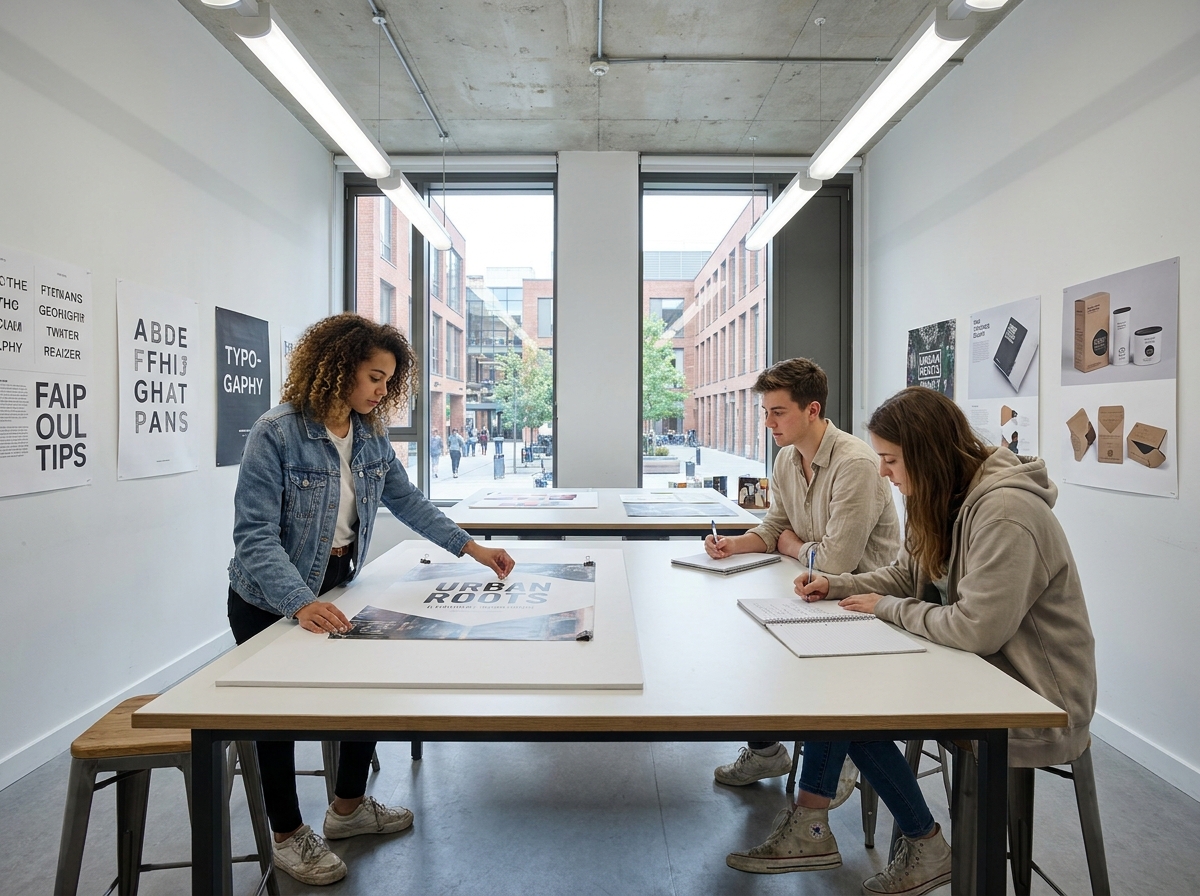
What takes up space are the transdisciplinary workshops combining graphic design, scenography, and animation. Design centers and schools organize collaborations where visual communication students work with profiles from interior architecture or motion design. The result: the projects submitted at the end of the semester resemble less like print boards and more like complete systems, with a digital component, a spatial component, and sometimes an editorial component.
For those seeking an overview of current graphic design programs, this reality is striking: compartmentalized courses are giving way to project formats where multiple disciplines intersect on the same deliverable.
The profiles of recent graduates confirm this trend. We see trajectories where the same graphic designer combines digital publishing, academic research, and interface creation. Schools are adapting their curricula to encourage these hybrid paths rather than training solely for the role of executing graphic designer.
Creative Tools and Programming: The Technical Curriculum of a Design Bachelor’s Degree
The Adobe suite remains essential, but the curricula now integrate front-end code (HTML, CSS, JavaScript) and sometimes Python applied to creative tools. A study day scheduled at the University of Strasbourg in June 2026, titled “When Code Meets Interface,” illustrates this movement well: it addresses programming applied to graphic design, not theoretical computing.
In practice, this means that a second-year student knows how to prototype a functional interface, not just draw it. The educational objective is not to train developers but to eliminate total dependence on developers for common digital deliverables.
Generative AI tools are also entering the workshops. We are not talking about an optional module at the end of the course, but an integrated component from the very first projects. Students learn to prompt, sort, and refine generated visuals, and above all, to justify their artistic choices in front of a jury. AI does not replace creation; it shifts the focus toward artistic direction.
What This Changes in a Student’s Toolbox
- Adobe Suite (Photoshop, Illustrator, InDesign) for production, supplemented by Figma or similar tools for interface prototyping
- Basic HTML/CSS/JS programming to understand web constraints and deliver realistic mockups
- Supervised use of generative AI tools, with an ethical and legal framework on copyright
- Motion design software (After Effects, sometimes Blender) for animated variations
Degrees and Jurys in Graphic Design: Changed Expectations
Professional certifications have evolved in recent years, with a breakdown into skill blocks that allow for validation of achievements by module. This is not just administrative: it changes how students prepare their end-of-year deliverables.
National juries, particularly those for the Diplôme National d’Art in graphic design, systematically include digital, interactive, or speculative projects. At isdaT, for example, the juries scheduled for 2026 highlight projects in experimental publishing, interfaces, and digital devices. Presenting only a series of printed posters is no longer sufficient to validate a degree.
This shift has a direct impact on daily training. Teaching teams guide projects toward formats that will be evaluated according to these new criteria. A final-year student dedicates a significant portion of their time to documenting their creative process, not just producing a polished final output.

Online Training and Work-Study in Graphic Design: Two Formats Redefining the Curriculum
Work-study programs already existed, but they are becoming increasingly significant in the curricula. Bachelor’s degrees in graphic design and digital offer apprenticeship paths from the first year in certain schools. The program adapts: classes are condensed into shorter periods, and academic projects are directly informed by real briefs handled in companies.
The rise of online training is also changing the game. Platforms offer complete courses leading to recognized certifications, with video conference classes, virtual workshops, and remote feedback on submissions. Opinions vary on this point: some graduates feel that the lack of physical confrontation with a jury or group limits progress, while others find in this format a flexibility that allows them to work simultaneously.
What does not change, regardless of the format: the practical component remains overwhelmingly dominant. A graphic design program, whether delivered in person or online, relies on projects to be submitted, not on theoretical exams to be ticked off.
- Work-study possible from the first year in several schools (apprenticeship or professionalization contract)
- 100% online training with RNCP certification, accessible in continuing education
- Hybrid formats combining periods in school and modules at a distance
The curriculum of a graphic design program in 2026 no longer has a clear boundary between print and digital, between creation and technique, between workshop and professional field. The students who graduate are no longer specialized executors on a software, but profiles capable of managing a visual project from start to finish, including when part of the work is delegated to a machine.