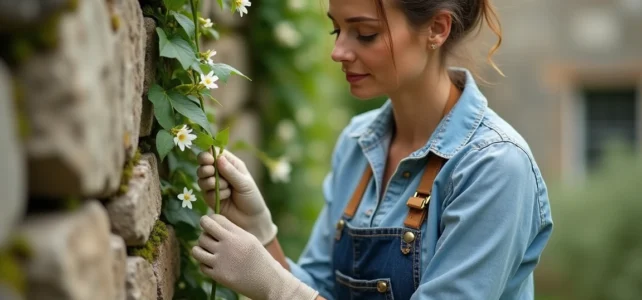
On a smooth plastered wall, star jasmine (Trachelospermum jasminoides) does not cling on its own. Unlike ivy or virgin vine, its twining stems need a support point to wrap around and climb upwards. Without suitable support, the plant will droop or spread out on the ground. The whole task is to choose the right structure, fix it correctly according to the type of wall, and then guide the stems during the first seasons.
Stainless steel cables on spacers: the right fix for insulated walls
It is often started with wooden trellis or plastic mesh, and this is a mistake on recent facades. Exterior insulation walls (ITE), increasingly common in residential areas, pose a concrete problem: fixings that only penetrate the insulation will pull out under the weight of the plant or in case of strong winds.
The solution that has developed since the early 2020s is the stainless steel cable kit on offset spacers. Manufacturers like Gaineko or Greenfix offer systems where the anchorage goes through the insulation to screw into the load-bearing masonry, with a spacer that keeps the cable a few centimeters away from the wall.
This offset is not just aesthetic. It creates an air gap between the foliage and the facade, which limits moisture stagnation, a point rarely addressed in traditional tutorials. To know how to make jasmine climb a wall without damaging the plaster, this logic of deep anchoring is what we must remember, even on an old wall.
The CSTB’s recommendations on green facades also emphasize this principle: never fix in the insulation alone, always in the masonry. Ignoring this rule risks creating a thermal bridge and a trellis that detaches after two years.
Trellis, taut wire, or mesh: what support for star jasmine on a wall
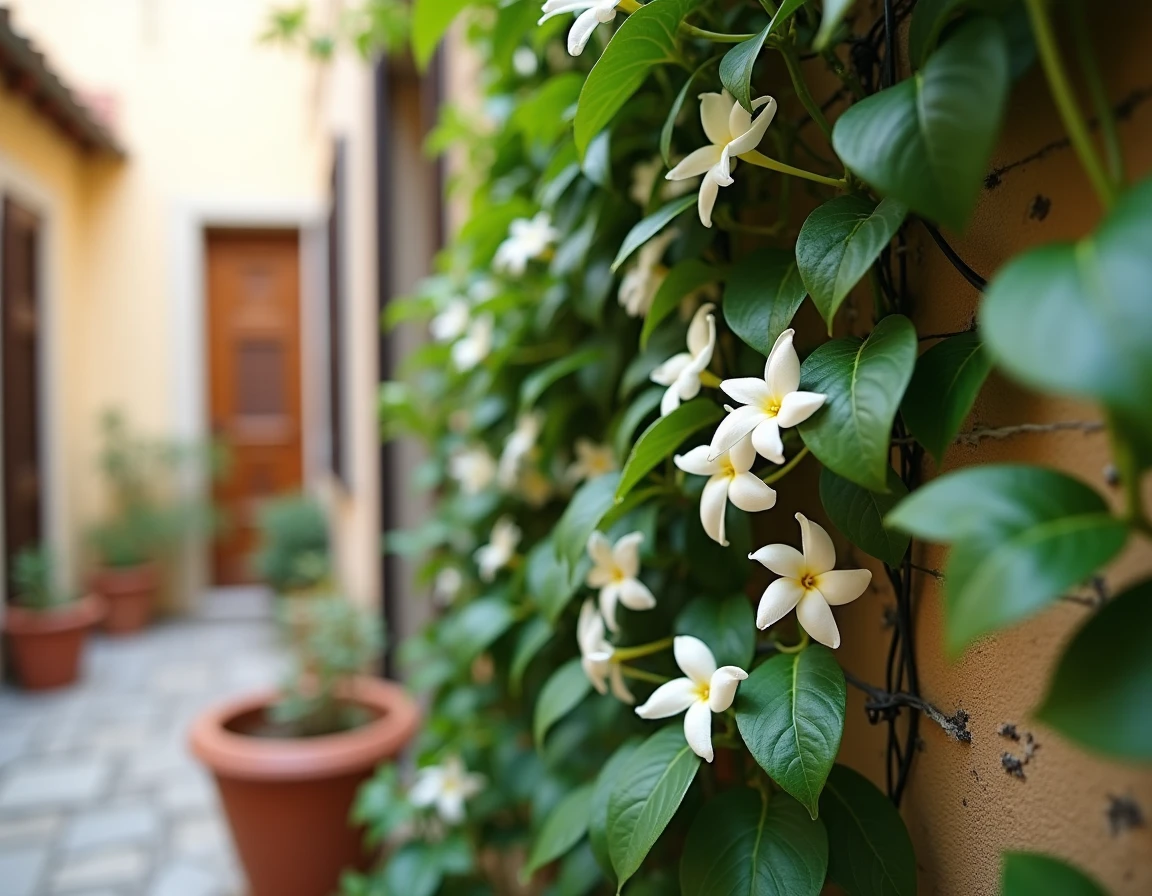
Star jasmine clings by wrapping its stems around thin supports. Therefore, we need narrow sections, not a thick post.
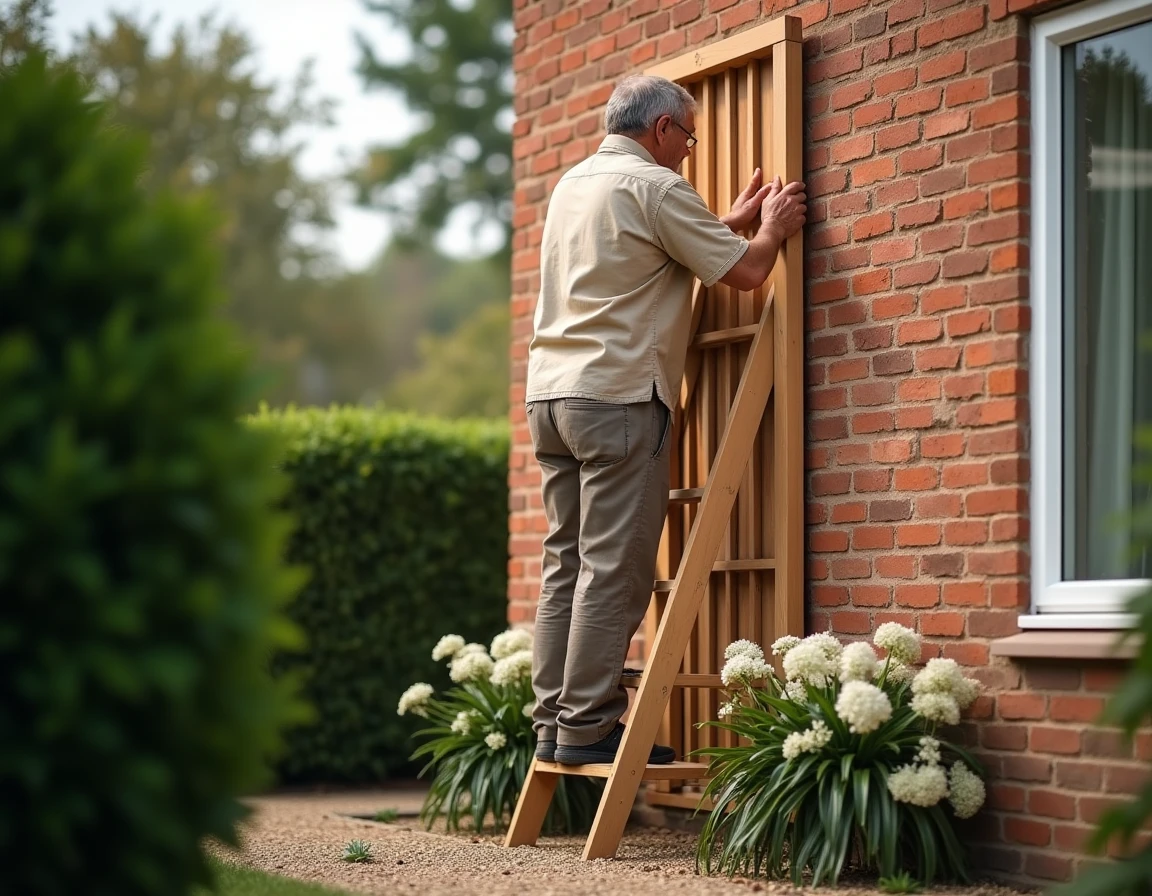
- Wooden trellis remains the most common. It can be found in diamond or square mesh. It works well, provided it is fixed with spacers of at least two centimeters to allow the stems to pass behind. A trellis pressed against the wall requires manual training of each branch.
- Stainless steel cables stretched horizontally every thirty to forty centimeters offer a more discreet appearance. This is the most suitable choice for modern facades or exposed stone walls that we want to keep visible in places.
- Welded rigid mesh (like fencing panels) is inexpensive and quick to install. It is suitable for large areas that need to be covered quickly, but its aesthetics leave something to be desired in the first year, before the foliage masks it.
As false jasmine is a dense plant that can reach several meters in height and spread, the support must be sufficiently robust to bear the weight of the mature foliage. A thin PVC trellis breaks after a few seasons under the load.
Guiding the stems of star jasmine during the first two years
You do not plant star jasmine at the foot of a wall hoping it will climb on its own. The first stems often grow horizontally or droop. Initial training makes all the difference.
Attach without tightening
Soft ties (raffia, coated gardening wire, foam collars) are used to secure the young stems to the support. Attaching the stems in an S-shape rather than purely vertically allows for more surface coverage and encourages lateral branching. The more the jasmine branches, the more evenly the wall will be covered.
Feedback varies on the frequency of training needed: some gardeners intervene every two weeks during the growing season, while others do so once a month. The idea is to guide the stems before they wrap around themselves or form a dense bundle at the bottom of the support.
Train in vertical cords to protect the facade
Several landscapers recommend training star jasmine in spaced vertical cords rather than a uniform mat. This technique leaves visible bands of wall between the cords, which allows the facade to dry after rain and limits moisture problems on the plaster.
Specifically, we select three or four main stems, guiding each one on a vertical cable, and trim the lateral shoots so they do not reach the neighboring cord. The result is graphic and much easier to maintain than a compact green wall.
Planting and maintenance at the foot of the wall
Star jasmine is preferably planted in spring, in well-drained soil that is not too calcareous. At the foot of a wall, the soil is often dry and compacted, sometimes enriched with construction debris.
Dig wide (at least double the pot) and amend with planting soil mixed with the existing soil. Planting at least twenty centimeters from the wall avoids the driest area and leaves room for the roots. Tilt the root ball slightly towards the support so that the first stems find their way naturally.
Watering is regular during the first year, especially in full south exposure where the wall reflects heat. In winter, star jasmine can withstand moderate negative temperatures. In regions with harsh winters, a south or southwest exposure protected from prevailing winds helps the climbing plant get through the cold season without damage to the following bloom.
Pruning occurs after summer flowering. Trim back the shoots that exceed the support, remove dead wood, and clear the wall fixings to check their condition. A well-trained star jasmine covers a wall in three to four seasons and produces its fragrant white flowers from May to August, requiring little more than an annual pruning and a solid support.