The quality of family ties is not measured by the number of shared meals, but by the regularity of meaningful interactions. A family that communicates daily about concrete topics (organization, emotions, projects) develops a cohesion that large occasional gatherings cannot compensate for.
Daily rituals and family ties: micro-interaction as a lever
We observe that families that maintain short but consistent rituals achieve better communication outcomes than those that rely on rare events. Rituals require neither budget nor logistics: they depend on repetition and predictability.
A few minutes of exchange at the same time each day, a meal taken together without screens, an open question asked to each child in the evening: these short formats create a secure framework. The regularity of the ritual matters more than its duration.
For families with young children, the bedtime ritual remains the most documented. With teenagers, car rides (school trips, activities) provide a conducive context for non-face-to-face exchanges, where reduced eye contact decreases perceived social pressure.
Practical resources compiled on the family page on Allo Papa allow for exploring different approaches tailored to each family configuration.
Parent-child communication: going beyond the functional
The majority of daily exchanges between parents and children revolve around logistics: homework, schedules, meals. This functional register does not nourish the emotional bond. It is necessary to introduce a second register, emotional or reflective, without turning every conversation into a therapy session.
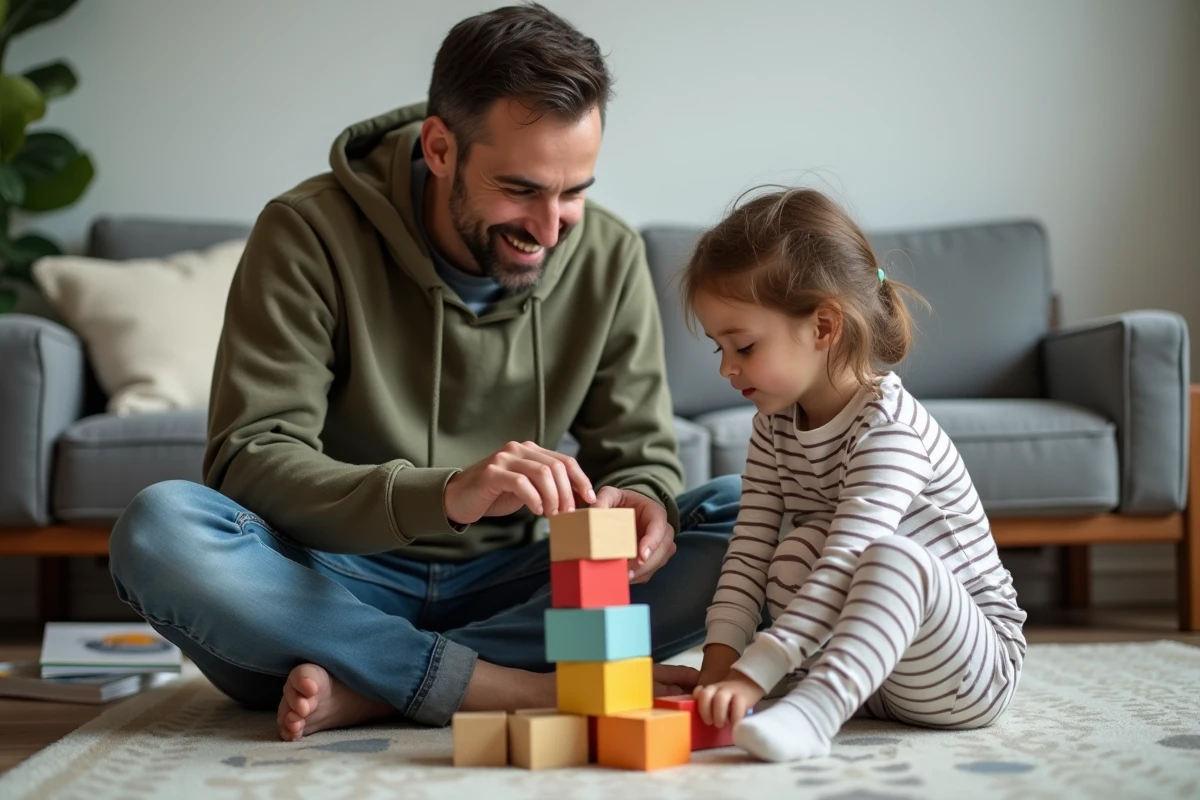
Asking a specific question produces a richer exchange than a generic question. “How was your day?” generates an automatic “fine.” “What surprised you today?” or “Who did you spend recess with?” opens up a narrative.
We recommend three concrete techniques:
- Active reformulation: repeating in your own words what the child just said, to validate that you understood and show that you are really listening
- Mutual sharing: recounting an episode from your own day at the same level of detail as what you expect from the child
- Attentive silence: leaving a pause after a short answer, without immediately prompting again, to allow the child to spontaneously elaborate
These techniques also work with seniors. Elderly individuals experiencing a loss of autonomy respond better to questions rooted in their long-term memory (“Tell me how Grandma prepared Christmas”) than to inquiries about the immediate present.
Shared family activities: choosing based on the desired connection
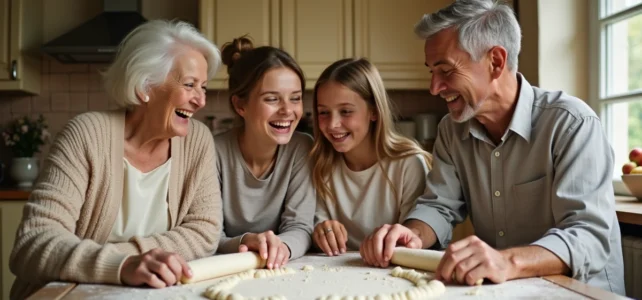
Not all activities strengthen the same relational dimensions. A competitive board game develops conflict management. A creative activity (cooking, DIY) fosters cooperation. An unstructured nature outing allows for free conversation.
The most effective activity is one that each member accepts without constraint. Forcing a teenager to participate in a board game produces the opposite effect of what is sought. We recommend offering a choice between two or three options rather than imposing an activity.
For families at a distance (separated parents, distant grandparents), synchronous remote activities work better than passive video calls:
- Cooking the same recipe simultaneously, each at home, with a call in the background
- Reading the same book or watching the same movie, then discussing it at a set time
- Playing an online game together, including simple games accessible to seniors
- Sending a physical object (drawing, printed photo, small gift) at regular intervals to maintain a tangible presence
Occasional gifts do not replace regular presence, but an intentionally chosen object signals that you are thinking of the other outside of shared moments.
Long-distance family relationships: maintaining the bond with seniors
The bond with an isolated elderly person deteriorates quickly without contact initiated from the outside. Seniors do not always reach out to their loved ones for fear of being a bother. The responsibility for initiating contact falls on the younger family members.

A short phone call (not necessarily video, as many seniors find video intrusive or tiring) at a fixed time is the most suitable format. The predictability of the call reduces anxiety related to waiting.
Involving children in this intergenerational contact benefits both parties. Grandchildren bring an energy and spontaneity that adults often filter out. Grandparents pass on stories, skills, and a connection to the extended family life.
For families with a member residing in a facility, contact should not be limited to visits. A postcard, a voice message, a photo sent by mail maintain the sense of belonging in daily life.
Family ties are built through the accumulation of brief and intentional moments, not by isolated grand gestures. Each deliberate interaction adds an extra layer of trust, and this trust forms the foundation on which relationships withstand tensions, distances, and time.