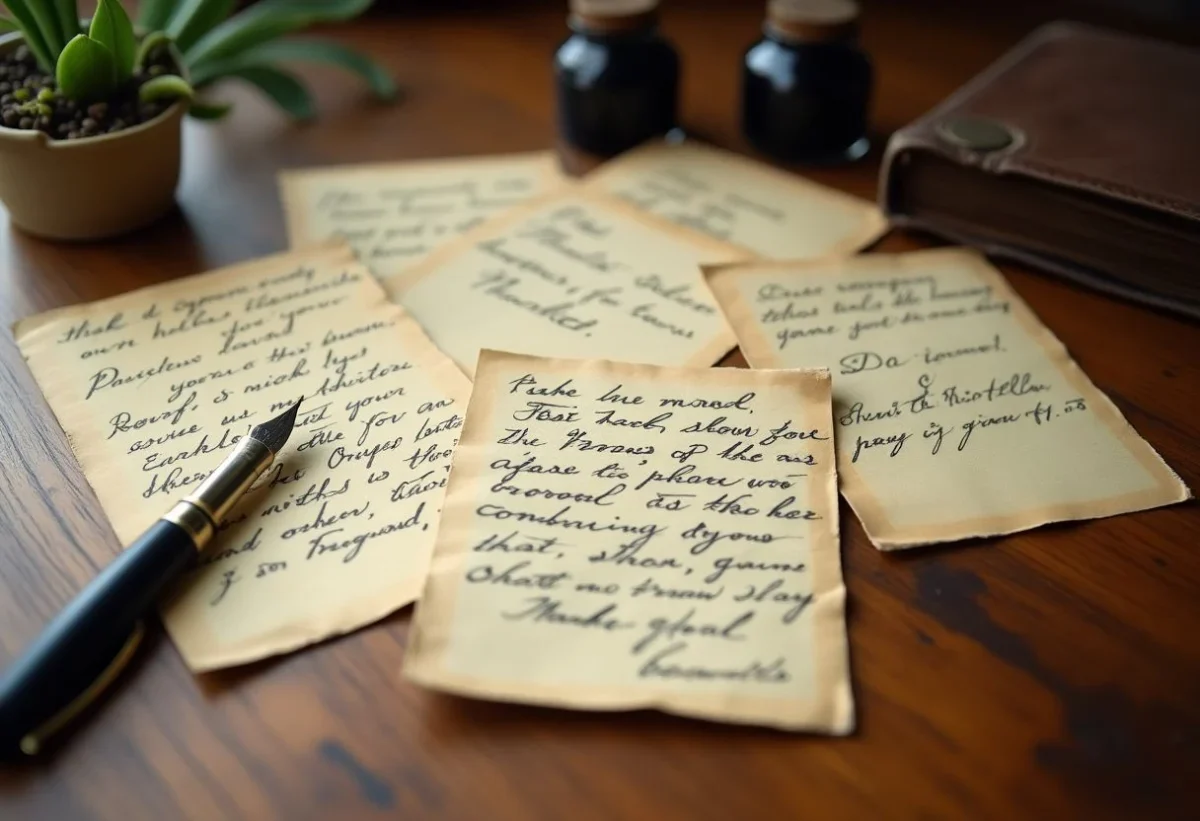
The card to send, this small piece of paper or cardboard, has traversed the ages. From a simple communication tool to a symbol of affection, it has managed to establish itself in our hearts. In our digital world where messages are exchanged at the speed of light, it retains a precious place. It reminds us of the importance of a personalized, tangible gesture that withstands the test of time. A handwritten message, carefully chosen and sent, has a particular resonance. This gesture demonstrates a unique attention, marking minds well beyond the instantaneity of digital exchanges.
The historical origins of the postcard
Before understanding the impact of cards to send, it is necessary to look into their origins.
Emerging in the 19th century, postcards were initially used as a simple and economical means of communication. Austria and Germany were among the first countries to adopt this format, allowing for a rapid exchange of information. Unlike our current digital exchanges, the postcard encouraged brief yet meaningful communication. The rise of tourism also played a role, enabling travelers to share their travel experiences with their loved ones.
They evolved over time, incorporating illustrations that turned them into true collector’s items. These illustrations ranged from picturesque landscapes to works of art, thus reflecting the culture and interests of the time. Their success was such that they became witnesses of history, capturing moments and places for future generations.
The evolution and diversification
As time passed, the card to send evolved to become much more than just a means of communication.
- Greeting cards: They emerged in the early 20th century, adding a new dimension to the tradition. Christmas celebrations, birthdays, weddings, every occasion found its dedicated card.
- Art cards: Artists quickly recognized the potential of cards as a medium, transforming these simple pieces of paper into miniature works of art.
- Animated cards: With advancements in technology, musical and 3D effect cards emerged, capturing the imagination of both young and old.
These transformations allowed cards to constantly reinvent themselves, adapting to the tastes and needs of each era while preserving their old-world charm.
The emotional impact of the card to send
Significantly, the emotion attached to receiving a card remains unparalleled.
Receiving a card to send is a unique experience. Opening an envelope, discovering the personalized message, feeling the touch of the paper, all of this creates a strong emotional bond. This simple gesture demonstrates particular attention and a desire to step away from the instantaneity of digital messages. It shows that time was taken to choose, write, and send this message. Each card carries a part of the sender, a fragment of their affection.
This creates memories that are preserved, displayed, and reread indefinitely. Cards thus become emotional treasures.
How the card to send adapts to the digital world
In our digital age, the card to send has not disappeared but has adapted, proving its resilience and timeless appeal.
- Electronic cards: They offer a modern alternative, allowing for instant wishes to be sent while retaining a personal touch through advanced customization options.
- Print on demand: Thanks to online services, it is now easy to create a unique physical card from digital templates and send it directly to the recipient.
- Card to send through social networks and applications, which allow sharing moments and memories in the form of virtual cards enriched with photos and videos.
These evolutions show that the card remains a vector of emotion and connection, even in the digital age, skillfully integrating with new technologies without losing its essence.